
Episode 606 ·
Steve Wozniak: A Look into the Mind of Apple's Co-Founder, a16z podcast Special
Today we’re bringing you a special episode from our friends at the a16z podcast. Listen in as one of the most influential technologists of our generation – Apple co-founder Steve Wozniak sits down with a16z host Steph Smith to discuss what inspired him to build a computer in the first place, but also how he thinks about the difference between inventors and engineers, and some special stories from the early days with Steve Jobs. Plus, you’ll get to hear about his new venture in space!
All of this right here, right now, on the Modern CTO Podcast!
For more about a16z, check out their website: https://a16z.com/
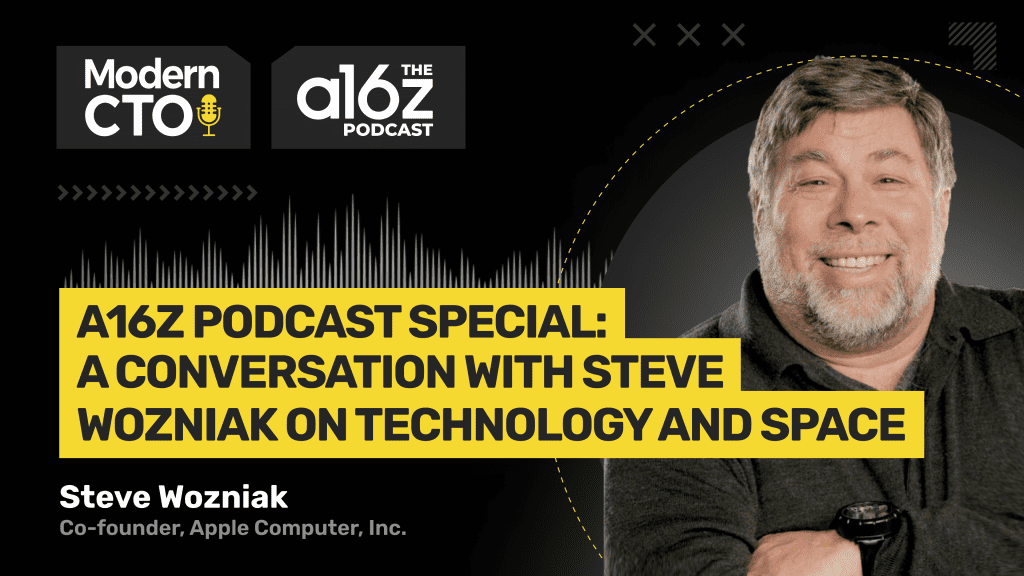
About Steve Wozniak:
Stephen Gary Wozniak also known by his nickname "Woz", is an American electronics engineer, computer programmer, philanthropist, inventor, and technology entrepreneur. In 1976, with business partner Steve Jobs, he co-founded Apple Computer, which later became the world's largest technology company by revenue and the largest company in the world by market capitalization. Through his work at Apple in the 1970s and 1980s, he is widely recognized as one of the most prominent pioneers of the personal computer revolution.
In 1975, Wozniak started developing the Apple I into the computer that launched Apple when he and Jobs first began marketing it the following year. He primarily designed the Apple II, introduced in 1977, known as one of the first highly successful mass-produced microcomputers, while Jobs oversaw the development of its foam-molded plastic case and early Apple employee Rod Holt developed its switching power supply. With human–computer interface expert Jef Raskin, Wozniak had a major influence over the initial development of the original Apple Macintosh concepts from 1979 to 1981, when Jobs took over the project following Wozniak's brief departure from the company due to a traumatic airplane accident. After permanently leaving Apple in 1985, Wozniak founded CL 9 and created the first programmable universal remote, released in 1987. He then pursued several other businesses and philanthropic ventures throughout his career, focusing largely on technology in K–12 schools.
Transcript
(Intro Narrator at 00:00:00) Today, we're bringing you a special episode from our friends at the a16z podcast. Apple co-founder Steve Wozniak sits down with a16z host Steph Smith to discuss what inspired him to build a computer in the first place. As you know, we're big fans of Woz, so it's awesome to hear his thoughts on inventors and engineers and some special stories from the early days with Steve Jobs, not to mention his new venture in space. For all of the Modern CTO fans, stay tuned for Joel's conversation with Steve coming this spring. If you're looking for more conversations about the innovators and tech trends shaping your future, from AI to genomics to supply chains to space, then make sure to subscribe to the a16z podcast wherever you get your podcasts.
(Intro Narrator at 00:00:47) With that said, take it away, Steph.
(Steph Smith at 00:00:51) What would you do if you co-founded the world's largest company? Would you do it again? Well, we're lucky enough to have someone on this Earth whose answer is, "Why not?" That person is Steve Wozniak. In today's episode, we're sharing a portion of our Privateer interview with Steve.
(Steph Smith at 00:01:07) Privateer, of course, is his new company, but also some never-heard-before footage with his best man and his coworker of many decades, who also happens to be Privateer CEO, Alex Fielding. Now, as you listen, you might ask, why are we sharing this? Well, I was excited to share this because we're at that inspiring part of the year where you think you can accomplish just about anything in the remaining 300-plus days, maybe even change the world. And there are few things more inspiring than hearing from someone who did. In this short episode, you'll get an inside look into the brain and heart of Woz, but also the curiosity that led to game-changing technologies that many of us benefit from today, like the phones—or as I like to say, pocket computers—or AirPods that you're probably using to listen to this episode.
(Steph Smith at 00:01:48) If you'd like to hear the full episode and get up to speed on Privateer, the company that Alex, Woz, and their co-founder Moriba are working on to clean up the next frontier, then check out episode 684, "The Data Highway Above." Let's start this episode by hearing from Steve Wozniak directly about what inspired him to build a computer in the first place.
(Disclaimer Narrator at 00:02:08) The content here is for informational purposes only, should not be taken as legal, business, tax, or investment advice, or be used to evaluate any investment or security, and is not directed at any investors or potential investors in any a16z fund. For more details, please see a16z.com/disclosures.
(Steph Smith at 00:02:39) I had the privilege of talking to Alex yesterday, and he told me the story about you from the very, very early days where, when you were younger, you basically told your dad, "Hey, Dad, I want to have a computer someday." And he said—because at this time, this is true—he said, "You're crazy. Computers cost as much as that house." And you told him, "Well, Dad, I live in an apartment."
(Steph Smith at 00:02:57) And you seemed to really, really just want a computer at that time. To your point earlier, starting Apple was not about building one of the biggest businesses in the world. It was wanting a computer and wanting other people to have that. I'm curious just to know, from a personal perspective, what did you see back then? Was it truly just a personal need for this device?
(Steph Smith at 00:03:17) Or I want to dig into that early Woz brain and hear your perspective on what was going on in those early days.
(Steve Wozniak at 00:03:24) A lot of great things come personally, and I learned—even I taught middle school and elementary school for eight years straight, full-time. Full-time, like every hour of the day, up to seven days a week. No press allowed, so it's not a big story. But I learned that it was less important that you're speaking facts and knowledge from your mouth. Knowledge was less importance than the motivation of my students to learn. Had to find ways to make it fun, make it understandable. And that's when I decided, you know what? Wanting something is even more important. And I go back: I wanted a computer. It was in my heart, and I didn't know if I'd ever, ever get it.
(Steve Wozniak at 00:03:55) I didn't know if designing computers would ever be a job for engineers, because we were back in the analog days, you know, smart math stuff. But I kept it in me, and eventually I found the path to do it. So I was building a computer for myself, and it turned out that the point in time—luck is sometimes there, there's a lot of luck in business success—and the point in time that I was going to build that computer, no matter what it was worth, turned out to be worth a ton. Now, governments have all the resources, you know, but they're stale in their approaches because of it: here's what we can do very successfully, very stably. We know we'll get there if we put enough money in and test enough.
(Steve Wozniak at 00:04:24) And private industry works so differently. I've only been in private, and I just love having ideas and thinking about them and thinking different and the creativity that comes about when you think, "My gosh, I could do something they haven't done before, or maybe the resources are cheaper." The sorts of huge computing devices are cheaper to make, and maybe certain types of motors, sensors that didn't exist before. You've got to always shoot for the top, being one of the leaders in the world, and that's just how we think.
(Steve Wozniak at 00:04:54) So, a lot of times when I think of government versus private, I also come down to types of people, which is very important. And you have an engineer who could be given a job, and they have the right skill sets, and they've gone through the right university, you know, majors and PhDs, and they're an engineer, and they can design what you assign them. But then there's the inventor. The inventor goes along, thinks, "Oh my gosh, is there something I'm interested in that I could do, and would it work? And maybe it hasn't been done before, and can I make a difference in the world?"
(Steve Wozniak at 00:05:22) The inventor wants to run into a laboratory, hook up some demos real quick, try to get some sort of prototype to show that the idea is right. And that's the sort of person I am. It's in your personality. You don't change it. You don't just say, "Tomorrow, I'm going to be an inventor. Today, I'm an engineer." You're usually one or the other.
(Steph Smith at 00:05:38) Yeah, definitely. Another word sometimes people use for inventor is visionary. And I'm curious, in the early days when you were just out of passion creating these computers, could you see the path to today? Of course, you can't picture everything with so many advancements since those early days, but how far along were you actually envisioning? And I'm asking this partially because even if we apply this to space, a lot of the things that people talk about also sound kind of like science fiction, right? They probably won't be eventually. But I'm trying to understand how far along you see, or the extrapolation that maybe goes on in your brain when you're originally talking about, yes, a computer with 200 transistors, and now we're talking billions, and the applications that have kind of sprung from that.
(Steve Wozniak at 00:06:22) I myself, I was really a great engineer in a certain field, and I was designing the hottest products in the world for Hewlett-Packard without even having a college degree yet. And then you talk about visionary, vision, seeing the future. That's different than invention, though. An inventor really wants to actually go in and create something today that didn't exist and not have a vision that's 50 years out or 10 years out, because that's science fiction a lot. And everybody can talk about it, and they'll say later on, "See, I proposed it," but it wasn't really possible to do with money.
(Steve Wozniak at 00:06:43) And the engineer says, feet on the ground, what can I actually do and build and deliver to people? When we started Apple, you know, we had a great product that was going to be all the revenues of Apple for the first 10 years. We had a great lead. We were comfortable. We could do what we wanted. But the amount of memory that would hold a song cost—you know, we were recreating the days of tape—it cost about a million dollars, a good fraction of a million dollars. Do you think we saw it today where you have a device in your hand with a thousand songs on it even? No.
(Steve Wozniak at 00:07:17) Steve Jobs was very instrumental in always taking us: do what we can do today, try to do something a little more tomorrow, a little more. You can have a lot of failures, too, if you'll have one great product bringing in the revenues. But the whole idea was we'll move towards the future and we'll be a part of it, and we'll be in with it. And, after all, if you look back, it was kind of invisible, the steps we took, but they all led to today. Steve Jobs' Apple II was really the iPod music, music. And that was the first time—oh my gosh, up till then our company valuation was the same as the old Apple II days—and then all of a sudden we sold it to everyone in the world, and our sales doubled, our profits doubled, and the board gave Steve Williams stock options and jet airplanes. That was the turning point.
(Steve Wozniak at 00:07:41) And then the iPhone was even better, and it was based on the iPod, not the reverse. Not a phone that will include an iPod, more like it's an iPod, but you get a phone with it. And so it's hard to say that you really see the future more than a year ahead when you're working a year ahead on your projects. Whenever I tried to see the future a year ahead, I knew it one year ahead because I was working on it. If I looked two years ahead and made some guesses, oh my gosh, other aspects, other technologies, all came out of from outer space, and people's desire which way they wanted to go was different. It's very hard to predict even two years ahead successfully the way I work.
(Steve Wozniak at 00:08:32) Nowadays we've got huge big companies, so it's kind of like, you know, anything they work on is going to be successful. It's not as much of a gamble. But, you know, real inventors like to gamble, like to prove the world that they can do more than you ever imagined.
(Steph Smith at 00:08:46) Now here's Alex reflecting on what it's been like to work with someone so influential over the years, getting to witness just how human even those who are superhuman are.
(Alex Fielding at 00:08:54) We've known each other for a long time, but I will say, working between him and getting to work with Steve Jobs back in my time at Apple, the thing that's interesting—I was helping Woz clean out his garage. This is a true story. Like, you don't think about Woz cleaning out his garage, right? But in his garage, I came across a blue three-ring binder, and it was filled with HP graph paper from when he worked at Hewlett-Packard before they started Apple.
(Alex Fielding at 00:09:18) And he was moonlighting, working on his designs for Apple I and Apple II. And this was a solo endeavor. I mean, this is different from the type of endeavors that we have to do at the scale, right? But I'm going through it page by page as an engineer and looking at every trace and every chip that he hand-drew on every page for Apple I and Apple II, and then in assembler for Apple ROM and Apple DOS.
(Alex Fielding at 00:09:44) And then I get to the back of this book that is—it's an engineering PhD manifesto that I don't think you could create today. Like, this should be a part of engineering school curriculum for every kid that wants to go into STEM. At the back of the same book, on the same HP graph paper, before he started Apple, were handwritten song lyrics from the Beatles and Bob Dylan that he had heard on the radio while he was working on Apple I and Apple II. And I thought, man, how can you be the human that did this and be the human that cared enough to write this down and to live by those things?
(Alex Fielding at 00:10:26) And I think it is important that we make a difference and we make an impact. And, you know, there are a lot of things that on planet Earth are technology projects that I really don't care about. I mean, I'm not the type of person that's going to go start the next Tinder, or, you know, the next—I'll skip all the other great app examples, but they're fleeting. And I'm a big believer that Elon oftentimes actually means what he says. Sometimes he doesn't. I mean, I think he's pretty damn funny. But I think sometimes he says exactly what he means and people glance over it because it sounds so crazy.
(Alex Fielding at 00:10:57) But all of these enabling step zones on the way to Mars, and on the way to an interplanetary species, on the way to ultimately a spacefaring civilization, all absolutely critical. And we can't start on it at the last minute. There's going to be a million baby steps to get that one giant leap, and we have to work on it now.
(Steph Smith at 00:11:17) Something I took from what you just shared there, even the example of seeing the drawings in Woz's garage, is that I think you've had the unique perspective or ability to see something from its very, very early stages, like those drawings, to obviously the giant that Apple became today, and getting to work with someone who had the capacity to understand something that can emerge from being a seed into something much, much bigger. Now here's where the bonus footage comes in. Here was Alex and I chatting after our interview was finished. Of course, we've confirmed with him this footage could be shared. You'll get to hear how Steve's zest for life was not only applied to computers, but also the rare opportunity to play Tetris on the side of a building or throw a concert across borders.
(Alex Fielding at 00:12:03) I think Steve is one of those very, very rare personality types where he can see and connect the dots forward, and it has never been a motivation of money, even at the start. Like Apple...
(Steph Smith at 00:12:17) He was just building computers for fun, right? Like, he was doing that well before Apple even existed.
(Alex Fielding at 00:12:23) Oh, yeah. I mean, he called me one time. I was working at a company with our former CTO at Apple. She left and took me with her. She ripped me out of Steve Jobs' hands, and unfortunately, she just passed away this year—Ellen Hancock. I mean, she is single-handedly responsible for saving Apple. And I say saving because when I was there, we were on the way to bankruptcy. And Ellen is the reason why Apple abandoned a very large multibillion-dollar software development project for a new operating system and went out and bought Steve Jobs' company NeXT and brought him back.
(Alex Fielding at 00:12:58) And one day, I get a call from Woz. I'm at my day job. I'm working for Ellen, and he calls me like 10:00 at night, and he goes, "Dude, do you remember when you told me if we could play Tetris on the side of a building, you would be there no matter what?" And I was like, "No, I don't remember saying that." And he was like, "You do."
(Steph Smith at 00:13:14) But you do.
(Alex Fielding at 00:13:15) And he was like, "I definitely remember it, and if you don't do it right now, you're not a man of your word. You're not a person of principles. You are just full of BS if you don't get on this plane with me and go play Tetris on the side of the Brown University library building in Rhode Island tomorrow morning." Oh my God. I love that.
(Alex Fielding at 00:13:33) Steve, I manage a bunch of people, and I can't just bail. Like, what do you mean tomorrow morning? He's like, "I already booked you a plane ticket. Seven in the morning. We're going."
(Alex Fielding at 00:13:42) And I was like, "Dude, I can't just up—it's 11:00 at night, right? What am I going to do?" So he goes, "You have to do it." So I call Ellen, I call my management chain. I'm like, "I've got a once-in-a-lifetime opportunity. I have to do it. I'm going to be gone for like three days." I'm just thinking...
(Steph Smith at 00:14:00) Get me playing some Tetris.
(Alex Fielding at 00:14:02) Play you some Tetris. Next thing I know, I'm in Rhode Island. I'm across the street from the Brown University library building with Steve. We're playing Tetris using the whole building as a display.
(Steph Smith at 00:14:11) Oh, that's amazing.
(Alex Fielding at 00:14:12) They took Christmas tree lights and relays and they lit all the windows so that we could play it. And there was a live Russian band behind us playing Tetris music while we were playing. So I don't think anything of it. And Steve and I are playing stupid pranks on each other the whole time. I fly home. Ellen calls me. "Come in my office." "What?" "Okay."
(Alex Fielding at 00:14:30) So I go in her office. I'm a total idiot. No idea what's going on. She goes, "Family emergency?" I was like, "Family emergency?" I was like, "No, no, no. Once in a lifetime." She whips open the New York Times. There's a picture of Steve and I playing...
(Steph Smith at 00:14:43) I couldn't find this. Do you—is it still online? Probably.
(Alex Fielding at 00:14:47) It's got to be out there somewhere. And she was like, "What about this?" And I go, "Well," and it was a once-in-a-lifetime...
(Steph Smith at 00:14:55) Opportunity.
(Alex Fielding at 00:14:56) I had to do it.
(Steph Smith at 00:14:57) You're like, "You know Steve?"
(Alex Fielding at 00:14:59) I know.
(Steph Smith at 00:14:59) You know? And it's like, and she—
(Alex Fielding at 00:15:01) She just—it was just terrible. But these types of things, I mean, he would call me in the middle of the night when we lived nearby each other and would go, "Milkshakes. We drive tonight. Bob's Big Boy in Burbank, we're going. We gotta get milkshakes." I'm like, "Steve, I can't just—" He's like, "You gotta do it. We gotta drive down right now." Drive from the Bay Area to Burbank to go get Bob's Big Boy. Yep, I do.
(Steph Smith at 00:15:26) I love these stories because, yeah, you hear—I mean, obviously, Steve is a legend, but it's always cool to see or hear these stories of him just wanting a milkshake or wanting to play Tetris with his friend. Those are awesome stories.
(Alex Fielding at 00:15:41) I've told him the biggest prank he's ever pulled is that he has tried to convince people that he is anything like us. He's not wired the same. He doesn't have—maybe this is just me. You know, Steve is one of those people, and he'll tell you this probably more than anything else. He's had a history with Steve Jobs. If Woz would come up with some crazy technology for fun, or for a prank, or something that he thought would improve the world, Steve Jobs would show up and be like, "How do we make money on this?"
(Alex Fielding at 00:16:07) And you need that combination of stuff to make businesses work. It's like Hewlett and Packard, or maybe it was Bill Gates and—I wouldn't even want to say Ballmer, but maybe it was Bill Gates and Paul Allen. I think you need those weird combinations of personalities. You can't have a diversity of ideas with a bunch of people that look and think the same.
(Alex Fielding at 00:16:28) So Steve's one of those very rare personalities. He threw the biggest concert on planet Earth because he missed Woodstock. Okay? He spent $40 million throwing a concert. He threw the US Festivals when I was a child. So 1983, he threw the US Festivals—bigger than Woodstock, more attendance, middle of California. He had to build the amphitheater to put it on. Lost $40 million on a concert because he wanted to have his own Woodstock. He just wanted to be there.
(Steph Smith at 00:17:02) That's amazing.
(Alex Fielding at 00:17:02) So he opened the gates. Right? And by the way, that event, it was really for the rest of us.
(Steph Smith at 00:17:07) Oh, God.
(Alex Fielding at 00:17:08) So he called it the US Festivals. And we're talking about that time—you know, Ozzy Osbourne and Judas Priest and Van Halen and Fleetwood Mac—and it was broken out by country day, hard metal day, classic rock day, folk day. So it was the first mega concert, multi-day concert thing outside of Woodstock. Well, at that event, we were in a hugely contentious environment in 1983. This is the fall of the Berlin Wall a year early. The Wall is still up. What does Steve do? He goes, "Man, we should go talk to the Russians, and we should set up a live satellite simulcast in both directions so that people in Moscow can attend the US Festivals remotely."
(Steph Smith at 00:17:56) That is so amazing because that is so far before the times.
(Alex Fielding at 00:18:02) Well, and he did it. One of my friends that got to go to both sides of it actually gave me his Russian pass to attend on the Moscow side because they gave him a pass. They're like, "Oh, it's lost. It's not gonna start a war."
(Steph Smith at 00:18:14) That's so amazing. But I mean, we talked about exponential curves before, and I just feel like so many people are very similar to each other, and then you have these people who are true outliers. They're just so different from the rest.
(Alex Fielding at 00:18:28) It's ridiculous, the number of very hysterical events over a couple decades of knowing Woz.
(Steph Smith at 00:18:36) I wanted to end this episode by coming full circle by hearing Alex touch on Woz's need to own a computer that fueled his desire to build one, touching also on John Draper's similar story of inventing the blue box just so he could make free phone calls. Such an elegant reminder that sometimes the best things in life come from a place of genuine curiosity and the need to solve a problem of your own.
(Alex Fielding at 00:18:56) I don't think wealth is in his vocabulary because it was never a desire. I remember when we first met, we were talking about what drove you to decide that you had to do Apple. And he was like, "I never had to do Apple. I had to own a computer. I wanted a computer." You know that. And I told him, I said, "Well, what was that like?" He told me his father was a brilliant engineer, and Woz is 10 times the engineer his father was. I mean, it's Jedi. I've never seen anything like it.
(Alex Fielding at 00:19:24) There are tricks that he pulled off before I was born that I still don't know how the hell he did them. And I will probably struggle, and that's the reason I think that book should be engineering curriculum, because there were genuine, brilliant tricks that he pulled to be efficient in his designs. That no one else would have done, but he needed to do it. He didn't have any money. Right? You have to be efficient. You have to be scrappy. And I asked him, "So do you know the moment you had to do it?" And he goes, "Yeah. I read about this thing called a computer, and I decided I really, really wanted one, and I went to my dad, who's this brilliant engineer"—I think his dad was at Lockheed because he was in the Bay Area, kind of old buzzard club rocket people. Space is a recurring theme for all of us. And he said, "Dad, I really—I want to have a computer someday." And he said his dad told him, "You're crazy. Computers cost as much as a house. You're never going to own a computer." And Steve's answer right away was, "I'll live in an apartment."
(Steph Smith at 00:20:21) Oh.
(Alex Fielding at 00:20:22) And that tells you almost everything you need to know. Could he see the steps beyond the thing that he was doing? I believe there was an intuition. There might not have been, "I know exactly Tinder's going to exist." I don't think that was 1976. I don't think that was the basis of any of these crazy people doing crazy things. And all of these things for Steve—blue boxes, he didn't invent the blue box. I mean, Captain Crunch, that crazy bastard, obviously invented the blue box so that he could hack the telephone system to make free phone calls. Steve, it was a challenge for himself. He didn't want to sell them. He wanted to take what one person was doing with analog electronics and make it digital, and see if he could do it. And of course, he did it, and then Steve Jobs jumped into him, and they actually used part of their blue box sales revenue from Berkeley to finance Apple. They sold their most personal possessions. Steve Jobs sold his Volkswagen thing. Woz sold his HP calculator. They used those monies to bootstrap Apple into existence. Those are stories of conviction because there's nothing to fall back on. Right? You can't go back. You can only go forward. Burn the boats.
(Steph Smith at 00:21:30) Right. Burn the boats. I know. And wow. It's so cool. It must be so cool to have seen all this over the many decades you've known him, and it must be very interesting also to be working on something that—you know the visionary level that Woz is. And if he cares so much about this topic and you equally care about the topic, which is cleaning up space and improving it and making it more collective, that must be so cool to get to work with someone who has that level of vision and to align with it and get to build something that is bigger than you.
(Alex Fielding at 00:22:01) Well, it's been 20 years since he decided he wanted to be president of anything, and I love that he's president of this.
(Steph Smith at 00:22:08) Again, that was Alex Fielding, CEO of Privateer, reflecting on his many years of friendship with Steve Wozniak. If you're interested in what both of them are building today, alongside their cofounder Moriba, again, check out episode 684, "The Data Highway Above," where they discuss the growing amount of space debris and what they're doing to fix it. I'll leave you with my favorite part of that episode.
(Moriba Jah at 00:22:29) All of outer space is probably infinite, but where we put satellites, that's actually finite. In fact, we put satellites on very specific orbital highways. They're very close to Earth. In fact, where are you right now, Steph?
(Steph Smith at 00:22:43) I am in Encinitas, California.
(Moriba Jah at 00:22:46) So I'm closer to lower orbit than I am to you. And I think that's what people just don't realize.
(Steph Smith at 00:22:56) Thanks for listening to the a16z podcast. If you like this episode, don't forget to subscribe, leave a review, or tell a friend. We also recently launched on YouTube at youtube.com/a16z_video, where you'll find exclusive video content. We'll see you next time.